Central Texas Economic Growth: What the Innovation Symposium Revealed
Central Texas economic growth took center stage in Killeen as leaders from Fort Hood, Texas A&M, our community colleges and industry tackled one question: how do great ideas become real jobs, real products and a stronger region? Here is what our team heard, and what it could mean for the people who call Central Texas home.
$29BFort Hood's estimated economic impact in Texas
~1,000Soldiers leaving Fort Hood each month, many choosing to stay local
~200New soldiers arriving at Fort Hood every week
60 GWProjected growth in Texas power demand
Central Texas economic growth was the thread running through every session at this year's Innovation Symposium at Texas A&M University–Central Texas. Our broker-owner, Jose Segarra, a 10-year Army veteran and former three-term Mayor of Killeen, spent the day listening to generals, researchers, educators and entrepreneurs. The message was clear and encouraging: the Fort Hood region is being positioned as one of the most important places in Texas to build, train and grow.
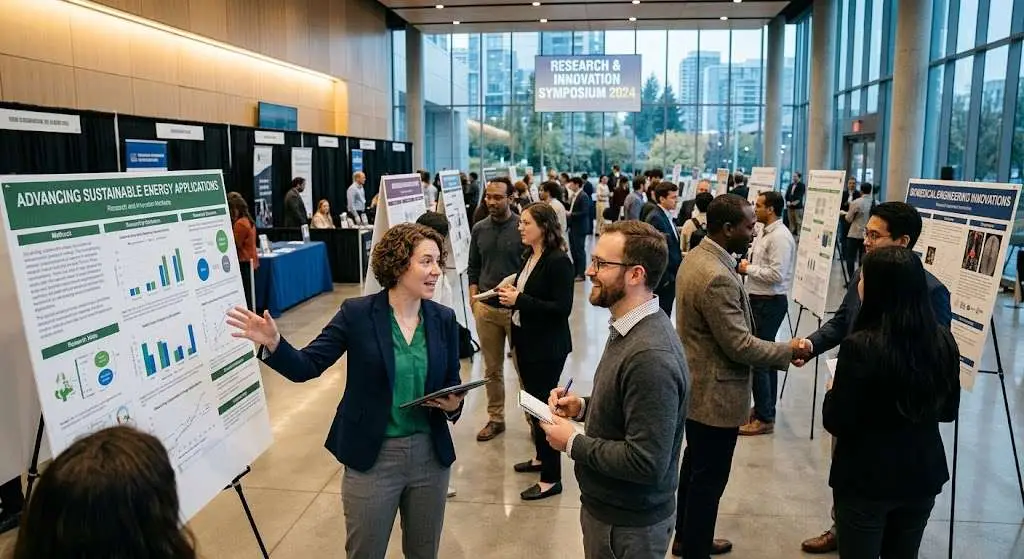
The Innovation Symposium brought industry, academia and government together in Killeen to discuss Central Texas economic growth.
Crossing the "Valley of Death"
The symposium, hosted by Texas A&M University–Central Texas, focused on a problem every inventor knows well. Plenty of promising technology gets built in a lab, but far less of it ever becomes a product people actually use. Speakers called that gap the "valley of death," and the whole day was about building bridges across it so that local research turns into Central Texas economic growth.
University President Dr. Richard Rhodes summed up the approach in one line: innovation plus collaboration equals transformation. The room reflected that. Industry leaders, Army officers, Central Texas College, Temple College, local chambers, economic development groups and the full Workforce Solutions Central Texas board were all in attendance.
Fort Hood: The Engine of Central Texas Economic Growth
State Representative Brad Buckley called Fort Hood, "the Great Place," the most underappreciated asset in the state of Texas, with an economic impact he estimated at about $29 billion. But he stressed that the bigger story is the people: soldiers who serve here, separate here and choose to make Central Texas their home.
Col. Ryan Barnett, Chief Technology Officer for III Armored Corps and Fort Hood, put numbers to that flow. Fort Hood is home to roughly 35,000 soldiers and about 80,000 people when families, contractors and civilians are included. About 200 new soldiers arrive every week, and up to 1,000 a month move on, either to a new duty station or into civilian life right here.
Why this matters to us
As a veteran-owned brokerage, we have seen for decades how many military families fall in love with Killeen, Harker Heights, Copperas Cove, Belton and Temple. New efforts to help transitioning soldiers find careers here give even more families a reason to put down roots, and those families are a big part of Central Texas economic growth.
Rep. Buckley helped secure a state line-item appropriation for the Military Talent Pipeline at Texas A&M–Central Texas, which helps soldiers leaving Fort Hood find the right civilian career path and support. His view of the region was simple: "no region in the state of Texas is better positioned to be the next big thing."
New Training Pipelines Fueling Central Texas Economic Growth
A recurring theme was that the region has plenty of good technology. What it needs is trained people, and workforce training may be the single biggest driver of Central Texas economic growth. Several concrete programs came up:
Edge Coding at A&M–Central Texas
Fort Hood recently contracted with the university to train soldiers in battlefield software skills, so they can build or adjust tools with AI in about 24 hours.
Advanced Manufacturing at CTC
Central Texas College is expanding hands-on robotics and manufacturing training, with dual-credit pathways starting in high school.
3D Printing for Soldiers
A new contract with a local school will train soldiers in additive manufacturing, supporting a 3D printing capability on post.
Sandra Duarte of Central Texas College shared national data showing manufacturing could face up to 1.9 million unfilled jobs by 2033. Her advice to educators: teach transferable skills, give students hands-on experience before day one, and build teamwork and communication through real projects.
Innovation Happening Right at Fort Hood
Much of the afternoon showed that cutting-edge work is already underway just down the road. III Armored Corps launched Phantom X, a new experimentation cell that connects the Army with universities and industry to move good ideas into soldiers' hands faster. The goal is to shrink a process that once took about seven years down to three or four, and every company that comes to Fort Hood to test and build adds to Central Texas economic growth.
Effort
What It Means Locally
Phantom X (III Armored Corps)
A front door for companies and universities that want to solve real soldier problems, from medical evacuation to sensor integration.
Army Applications Lab / Overwatch
About 20 companies are prototyping autonomy and robotics alongside a 1st Cavalry Division brigade in training.
Autonomous logistics trucks
Self-driving kits for Army PLS trucks were demonstrated off-road at Fort Hood, with dozens planned for fielding.
AI training and simulation
Texas companies are building VR and AI tools for soldier training, tutoring and advanced manufacturing.
Lt. Col. Nick Rinaldi of the Army Applications Lab made a direct request to local chambers, colleges and economic developers: help build places where companies can test ideas with soldiers in a low-stakes setting. That kind of ecosystem brings new businesses, and new employees, to Central Texas, adding momentum to Central Texas economic growth.
Semiconductors, RELLIS and the Statewide Picture
Clay Huber of the Texas A&M Semiconductor Institute, a Navy veteran himself, described a new 80,000-square-foot research facility being built at the Texas A&M RELLIS campus with a $226 million state appropriation. It is designed so researchers, startups, industry and students can work side by side, with the goal of cutting time to market in half. Statewide investments like this ripple outward and support Central Texas economic growth as well.
His passion was workforce. He believes most people do not need a four-year degree to do hard, skilled, well-paying work, and that the right training and a clear pathway can change a life. For transitioning soldiers with technical backgrounds, that is a powerful message.
Power for the Future: A Microreactor Near Fort Hood?
One of the most eye-opening talks covered advanced nuclear energy. A Texas A&M representative explained that Texas power demand is projected to grow by about 60 gigawatts, driven by AI, manufacturing, population growth and water needs. Reliable power and water are the foundation of Central Texas economic growth, a point State Rep. Buckley also made about water earlier in the day.
He noted that a company is seeking to place a small reactor of roughly 5 megawatts at Fort Hood, using the same type of fuel Texas A&M has safely operated in its campus reactor since 1962. A federal directive calls for operating reactors on military installations by September 2028, and he expects a public engagement process in our area over the next couple of years.
Modern microreactors are small, with safety planning zones about the size of the site itself. Texas A&M offered to host Fort Hood-area community leaders for tours of its reactor.
Planning Your Next Move in Central Texas?
Whether you are transitioning out of the Army, relocating for a new career or growing your family as part of Central Texas economic growth, our veteran-led team has helped with 5,000+ closings across the Fort Hood area since 2005. Ask us about Homes for Heroes savings for service members and heroes.
What Central Texas Economic Growth Means for Homeowners and Buyers
No single conference can predict the housing market, and we will not pretend otherwise. But the direction of Central Texas economic growth is worth paying attention to. When soldiers have clear career paths here, when colleges train people for skilled jobs, and when companies come to Fort Hood to test and build, more families have reasons to stay and more newcomers have reasons to move in.
If you are transitioning out of the Army
Here is how to position yourself to benefit from Central Texas economic growth:
Explore local career pathways early. Look into the Military Talent Pipeline at Texas A&M–Central Texas and training programs at Central Texas College and Temple College.
Decide whether to stay. If a civilian career keeps you in Central Texas, buying may make more sense than renting. You can search homes for sale across Central Texas to get a feel for the market.
Use your VA home loan benefit. Talk with a VA-savvy lender and a veteran agent who understands PCS and separation timelines.
Pick the right community. Killeen, Harker Heights, Copperas Cove, Belton, Temple and Salado each offer something different in commute, schools and lifestyle.
If you already own a home here
Stay informed about new employers, training programs and infrastructure projects near you. These are the kinds of long-term changes that shape where people want to live, and they are the building blocks of Central Texas economic growth. Our agents at Homevets Realty are happy to talk through what is happening in your neighborhood.
Frequently Asked Questions
What was the Innovation Symposium at Texas A&M-Central Texas?
It was a one-day event in Killeen that brought together industry, universities, community colleges, local government and Fort Hood leaders to discuss how to move research and new technology from the lab into real-world use, and how to build the workforce to support Central Texas economic growth.
How does Fort Hood affect Central Texas economic growth?
State Rep. Brad Buckley estimated Fort Hood's economic impact at about $29 billion. Beyond that, many of the up to 1,000 soldiers who leave the installation each month choose to stay in the area, adding skilled workers, entrepreneurs and new homeowners to the region.
What is Phantom X?
Phantom X is a new experimentation cell within III Armored Corps at Fort Hood. It connects the Army with universities and industry to test new technology with soldiers and speed up how quickly useful tools reach the field.
Is a nuclear reactor coming to Fort Hood?
According to a Texas A&M speaker, a company is seeking to place a small reactor of roughly 5 megawatts at Fort Hood, and a federal directive calls for operating reactors on military installations by September 2028. Nothing is final, and a public engagement process is expected.
What resources exist for soldiers transitioning out of Fort Hood?
Texas A&M University-Central Texas runs a Military Talent Pipeline for transitioning soldiers, and Central Texas College and Temple College offer career training. If you plan to stay in the area, Homevets Realty can help you use your VA home loan benefit and find the right community.
Figures and projections about Central Texas economic growth in this article reflect statements made by speakers at the symposium and have not been independently verified by Homevets Realty.
Central Texas economic growth took center stage in Killeen as leaders from Fort Hood, Texas A&M, our community colleges and industry tackled one question: how do great ideas become real jobs, real products and a stronger region? Here is what our team heard, and what it could mean for the people who call Central Texas home.
Central Texas economic growth was the thread running through every session at this year's Innovation Symposium at Texas A&M University–Central Texas. Our broker-owner, Jose Segarra, a 10-year Army veteran and former three-term Mayor of Killeen, spent the day listening to generals, researchers, educators and entrepreneurs. The message was clear and encouraging: the Fort Hood region is being positioned as one of the most important places in Texas to build, train and grow.
The Innovation Symposium brought industry, academia and government together in Killeen to discuss Central Texas economic growth.
Crossing the "Valley of Death"
The symposium, hosted by Texas A&M University–Central Texas, focused on a problem every inventor knows well. Plenty of promising technology gets built in a lab, but far less of it ever becomes a product people actually use. Speakers called that gap the "valley of death," and the whole day was about building bridges across it so that local research turns into Central Texas economic growth.
University President Dr. Richard Rhodes summed up the approach in one line: innovation plus collaboration equals transformation. The room reflected that. Industry leaders, Army officers, Central Texas College, Temple College, local chambers, economic development groups and the full Workforce Solutions Central Texas board were all in attendance.
Fort Hood: The Engine of Central Texas Economic Growth
State Representative Brad Buckley called Fort Hood, "the Great Place," the most underappreciated asset in the state of Texas, with an economic impact he estimated at about $29 billion. But he stressed that the bigger story is the people: soldiers who serve here, separate here and choose to make Central Texas their home.
Col. Ryan Barnett, Chief Technology Officer for III Armored Corps and Fort Hood, put numbers to that flow. Fort Hood is home to roughly 35,000 soldiers and about 80,000 people when families, contractors and civilians are included. About 200 new soldiers arrive every week, and up to 1,000 a month move on, either to a new duty station or into civilian life right here.
Why this matters to us
As a veteran-owned brokerage, we have seen for decades how many military families fall in love with Killeen, Harker Heights, Copperas Cove, Belton and Temple. New efforts to help transitioning soldiers find careers here give even more families a reason to put down roots, and those families are a big part of Central Texas economic growth.
Rep. Buckley helped secure a state line-item appropriation for the Military Talent Pipeline at Texas A&M–Central Texas, which helps soldiers leaving Fort Hood find the right civilian career path and support. His view of the region was simple: "no region in the state of Texas is better positioned to be the next big thing."
New Training Pipelines Fueling Central Texas Economic Growth
A recurring theme was that the region has plenty of good technology. What it needs is trained people, and workforce training may be the single biggest driver of Central Texas economic growth. Several concrete programs came up:
Edge Coding at A&M–Central Texas
Fort Hood recently contracted with the university to train soldiers in battlefield software skills, so they can build or adjust tools with AI in about 24 hours.
Advanced Manufacturing at CTC
Central Texas College is expanding hands-on robotics and manufacturing training, with dual-credit pathways starting in high school.
3D Printing for Soldiers
A new contract with a local school will train soldiers in additive manufacturing, supporting a 3D printing capability on post.
Sandra Duarte of Central Texas College shared national data showing manufacturing could face up to 1.9 million unfilled jobs by 2033. Her advice to educators: teach transferable skills, give students hands-on experience before day one, and build teamwork and communication through real projects.
Innovation Happening Right at Fort Hood
Much of the afternoon showed that cutting-edge work is already underway just down the road. III Armored Corps launched Phantom X, a new experimentation cell that connects the Army with universities and industry to move good ideas into soldiers' hands faster. The goal is to shrink a process that once took about seven years down to three or four, and every company that comes to Fort Hood to test and build adds to Central Texas economic growth.
Effort
What It Means Locally
Phantom X (III Armored Corps)
A front door for companies and universities that want to solve real soldier problems, from medical evacuation to sensor integration.
Army Applications Lab / Overwatch
About 20 companies are prototyping autonomy and robotics alongside a 1st Cavalry Division brigade in training.
Autonomous logistics trucks
Self-driving kits for Army PLS trucks were demonstrated off-road at Fort Hood, with dozens planned for fielding.
AI training and simulation
Texas companies are building VR and AI tools for soldier training, tutoring and advanced manufacturing.
Lt. Col. Nick Rinaldi of the Army Applications Lab made a direct request to local chambers, colleges and economic developers: help build places where companies can test ideas with soldiers in a low-stakes setting. That kind of ecosystem brings new businesses, and new employees, to Central Texas, adding momentum to Central Texas economic growth.
Semiconductors, RELLIS and the Statewide Picture
Clay Huber of the Texas A&M Semiconductor Institute, a Navy veteran himself, described a new 80,000-square-foot research facility being built at the Texas A&M RELLIS campus with a $226 million state appropriation. It is designed so researchers, startups, industry and students can work side by side, with the goal of cutting time to market in half. Statewide investments like this ripple outward and support Central Texas economic growth as well.
His passion was workforce. He believes most people do not need a four-year degree to do hard, skilled, well-paying work, and that the right training and a clear pathway can change a life. For transitioning soldiers with technical backgrounds, that is a powerful message.
Power for the Future: A Microreactor Near Fort Hood?
One of the most eye-opening talks covered advanced nuclear energy. A Texas A&M representative explained that Texas power demand is projected to grow by about 60 gigawatts, driven by AI, manufacturing, population growth and water needs. Reliable power and water are the foundation of Central Texas economic growth, a point State Rep. Buckley also made about water earlier in the day.
He noted that a company is seeking to place a small reactor of roughly 5 megawatts at Fort Hood, using the same type of fuel Texas A&M has safely operated in its campus reactor since 1962. A federal directive calls for operating reactors on military installations by September 2028, and he expects a public engagement process in our area over the next couple of years.
Modern microreactors are small, with safety planning zones about the size of the site itself. Texas A&M offered to host Fort Hood-area community leaders for tours of its reactor.
Planning Your Next Move in Central Texas?
Whether you are transitioning out of the Army, relocating for a new career or growing your family as part of Central Texas economic growth, our veteran-led team has helped with 5,000+ closings across the Fort Hood area since 2005. Ask us about Homes for Heroes savings for service members and heroes.
What Central Texas Economic Growth Means for Homeowners and Buyers
No single conference can predict the housing market, and we will not pretend otherwise. But the direction of Central Texas economic growth is worth paying attention to. When soldiers have clear career paths here, when colleges train people for skilled jobs, and when companies come to Fort Hood to test and build, more families have reasons to stay and more newcomers have reasons to move in.
If you are transitioning out of the Army
Here is how to position yourself to benefit from Central Texas economic growth:
Explore local career pathways early. Look into the Military Talent Pipeline at Texas A&M–Central Texas and training programs at Central Texas College and Temple College.
Decide whether to stay. If a civilian career keeps you in Central Texas, buying may make more sense than renting. You can search homes for sale across Central Texas to get a feel for the market.
Use your VA home loan benefit. Talk with a VA-savvy lender and a veteran agent who understands PCS and separation timelines.
Pick the right community. Killeen, Harker Heights, Copperas Cove, Belton, Temple and Salado each offer something different in commute, schools and lifestyle.
If you already own a home here
Stay informed about new employers, training programs and infrastructure projects near you. These are the kinds of long-term changes that shape where people want to live, and they are the building blocks of Central Texas economic growth. Our agents at Homevets Realty are happy to talk through what is happening in your neighborhood.
Frequently Asked Questions
What was the Innovation Symposium at Texas A&M-Central Texas?
It was a one-day event in Killeen that brought together industry, universities, community colleges, local government and Fort Hood leaders to discuss how to move research and new technology from the lab into real-world use, and how to build the workforce to support Central Texas economic growth.
How does Fort Hood affect Central Texas economic growth?
State Rep. Brad Buckley estimated Fort Hood's economic impact at about $29 billion. Beyond that, many of the up to 1,000 soldiers who leave the installation each month choose to stay in the area, adding skilled workers, entrepreneurs and new homeowners to the region.
What is Phantom X?
Phantom X is a new experimentation cell within III Armored Corps at Fort Hood. It connects the Army with universities and industry to test new technology with soldiers and speed up how quickly useful tools reach the field.
Is a nuclear reactor coming to Fort Hood?
According to a Texas A&M speaker, a company is seeking to place a small reactor of roughly 5 megawatts at Fort Hood, and a federal directive calls for operating reactors on military installations by September 2028. Nothing is final, and a public engagement process is expected.
What resources exist for soldiers transitioning out of Fort Hood?
Texas A&M University-Central Texas runs a Military Talent Pipeline for transitioning soldiers, and Central Texas College and Temple College offer career training. If you plan to stay in the area, Homevets Realty can help you use your VA home loan benefit and find the right community.